
ARO Pulsation Dampers: Function, Benefits, and Proper Installation
Due to their operating principle, air-operated diaphragm pumps generate a pulsating flow. These pressure fluctuations can lead to vibrations, noise, and increased stress on piping, valves, and measuring instruments. An ARO pulsation damper can significantly reduce these effects and improve the efficiency of the entire system.
Particularly in industrial applications where a consistent flow rate is critical, pulsation dampers ensure greater process reliability and smoother plant operation.
What is a pulsation damper?
A pulsation damper is a pressure equalization tank that is installed directly on the discharge side of a compressed air diaphragm pump. It temporarily stores pressure energy and compensates for the pressure spikes caused by the pump's operation.
This results in a more consistent flow rate, which helps protect pipes, valves, and measuring devices. At the same time, vibrations are reduced and the strain on the entire system is minimized.
Why do pulsations occur in compressed air diaphragm pumps?
Pneumatic diaphragm pumps operate on the positive displacement principle. Due to the alternating movement of the diaphragms, the fluid is not transported continuously but in individual strokes. This causes pressure fluctuations that can propagate throughout the entire piping system.
Typical effects include:
- Pressure spikes in the piping system
- Irregular flow
- Vibrations and Noise Levels
- Increased stress on valves and fittings
- Inaccuracies in dosing and filling processes
The longer the piping or the more sensitive the application, the more important it is to use a pulsation damper.
Typical installation of an ARO pulsation damper
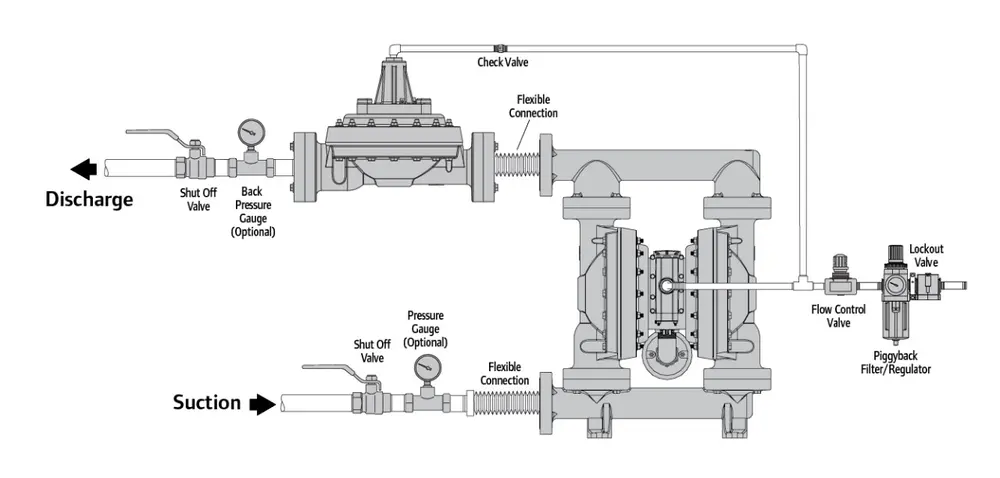
The following illustration shows the recommended installation of an ARO pulsation damper on a compressed air diaphragm pump. The pulsation damper is installed on the discharge side of the pump and reduces pressure spikes right at their source.

As shown in the diagram, the pulsation damper is installed directly downstream of the pump outlet. This compensates for pressure fluctuations and ensures a consistent flow rate. Flexible connections and appropriate shut-off valves further contribute to low-vibration operation.
Advantages of an ARO pulsation damper
Consistent flow rate
Reducing pulsations results in a much more consistent flow of the pumped medium. This improves process quality and the accuracy of downstream applications.
Less vibration and noise
Pulsation dampers reduce mechanical stress on the piping system and ensure smoother system operation.
Protection of Piping and Fittings
Pressure spikes can cause long-term damage to pipes, valves, and measuring instruments. A pulsation damper minimizes these stresses and helps extend the system's service life.
Greater process reliability
Especially in dosing, filling, and conveying processes, a constant flow rate ensures reproducible results and stable processes.
Typical applications
ARO pulsation dampers are used in numerous industries:
- Chemical industry
- Water and Wastewater Technology
- Paint and Coatings Industry
- Food industry
- Pharmaceutical industry
- General Plant and Mechanical Engineering
Selecting the Right ARO Pulsation Damper
The right choice depends on various factors:
- Pump size and connection size
- Flow rate
- Operating pressure
- Pumped medium
- Application requirements
A properly designed pulsation damper not only improves flow rate but also protects the entire system from unnecessary stress.
Buy ARO pulsation dampers online
Discover our range of high-quality ARO pulsation dampers for compressed air diaphragm pumps and industrial applications.